
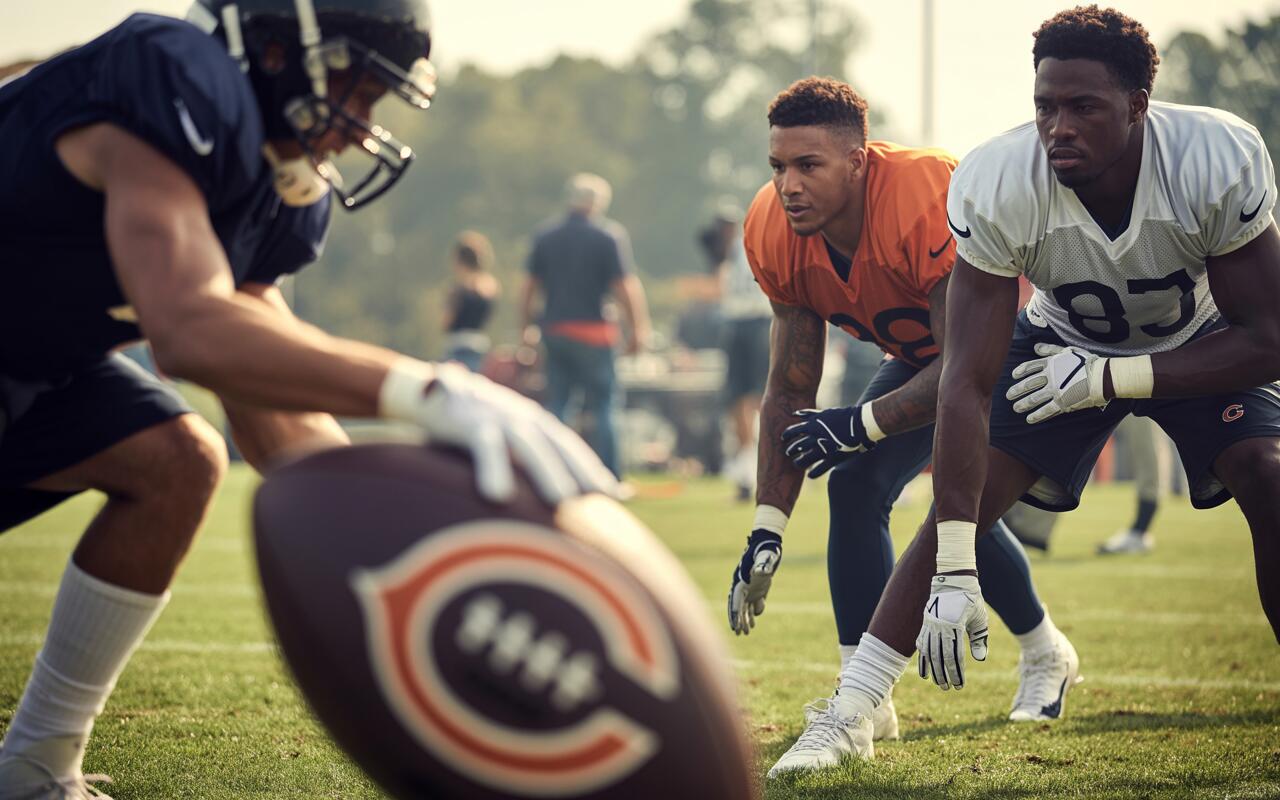

After Chicago’s brutal 52-21 beatdown at the hands of the Detroit Lions, it would be easy to write off Caleb Williams entirely. But dig deeper into the film, and you’ll find reasons for cautious optimism about the rookie quarterback’s development within Ben Johnson’s offensive framework.
Silver Linings in a Blowout Loss
Sure, a 31-point shellacking never looks good in the box score. Yet Williams managed to showcase several polished throws throughout the contest, demonstrating improved timing and accuracy while sticking to the game plan more consistently than in his debut. Yes, he threw a costly pick on one of those inevitable third-and-forever situations, but his decision-making process looked cleaner overall. The flashes of elite arm talent were there—both when he had a clean pocket and when things broke down around him.
Johnson didn’t mince words when evaluating his young signal-caller’s progress. \”I saw real improvement from Week 1 to Week 2,\” the Bears’ head coach noted Monday. \”He was getting to his third read, sometimes even his fourth, trusting his mechanics and making smart choices.\” That’s the kind of progression through reads and footwork that doesn’t always show up on highlight reels but matters enormously for long-term success.
Pocket Management Under Fire
Williams averaged 2.96 seconds before releasing the ball against Detroit—a tick higher than ideal, but that’s partly by design. Johnson’s offense leans heavily on intermediate and deep routes, with passing attempts averaging north of 10 air yards per throw. The four sacks Williams absorbed tell only part of the story. Two came from legitimate protection failures: D’Andre Swift whiffed on a blitzer, and Braxton Jones got beat clean on the edge. The other two? Williams held the ball appropriately while receivers worked through their routes against tight coverage.
What stood out was how Williams cleaned up some Week 1 miscues. Early against the Lions, he executed a beautiful play-action sequence that closely resembled a throw he’d missed in the opener. This time, he read the linebacker perfectly, used his eyes to move the defender toward Rome Odunze’s underneath route, then delivered a strike to D.J. Moore for 18 yards. Small details like that suggest he’s processing information faster.
Pre-Snap Recognition Coming Along
Williams flashed his developing football IQ on a touchdown toss to Odunze, barking out a \”Larry\” protection call to counter Detroit’s overload blitz. The adjustment worked perfectly, giving Williams a clean throwing lane to find his receiver in the flat. Those kinds of pre-snap reads and line adjustments? That’s graduate-level quarterback play from a rookie still finding his footing.
His lone interception came in a nightmare scenario—second-and-32 after penalty hell. Multiple receivers ran conflicting routes, the pocket collapsed, and Williams got caught trying to make something out of nothing under heavy duress. The offensive coordinator’s post-game comments about receivers not running crisp routes on certain concepts likely referenced this exact sequence.
Smart Scrambling and Pocket Mobility
Williams showed restraint in when to break containment, scrambling just four times all game. Two came under obvious pressure situations, and he converted both for decent yardage. The best example came late in the third quarter on a \”dagger\” concept where, after cycling through his first three reads and finding nothing, he calmly stepped up and gained nine yards through a seam in the pocket. That’s using athleticism as an extended checkdown option—exactly how modern quarterbacks should blend mobility with pocket discipline.
Connecting Downfield Against Elite Coverage
Despite facing Detroit’s aggressive secondary, Williams completed five passes of 15-plus yards, often threading balls into tight windows while staying within the offensive structure.
The best came on a third-and-15 out-and-up to Odunze. Even with the cornerback biting hard on the underneath fake, Williams still had to drop the ball over a charging safety. He nailed the timing and trajectory, hitting Odunze in stride without hanging him out to dry. Those are the throws that separate franchise quarterbacks from the pack.
Room for Growth
Williams isn’t without areas needing work. On a third-and-7 smash concept in the fourth quarter, Detroit showed an obvious overload blitz pre-snap. Rather than adjusting protection or finding the hot route to the flat, Williams locked onto Odunze’s corner pattern and fired into heavy traffic. Plays like that show where his defensive recognition and protection calls still need refinement.
The Path Forward
Quarterback development rarely follows a straight line, and ugly losses like Sunday’s can actually be more instructive than comfortable wins. Williams’ Week 2 performance, buried beneath the lopsided scoreboard, revealed a player adapting to Johnson’s system against legitimate NFL competition. With a vulnerable Dallas defense on deck, the Bears have a prime opportunity to build on these encouraging signs.
For Chicago fans still processing that ugly loss, Williams’ mission remains straightforward: keep his composure, trust the system, and lean into the positive momentum he generated against one of the league’s better defenses.
(Photo: Gregory Shamus / Getty Images)
